Before you quote DDP for an industrial pump delivered to Germany, settle who will arrange lawful import clearance, who will bear import VAT and how the sale will be invoiced. DDP allocates import obligations to the seller, but the three letters do not appoint a customs representative or settle German VAT treatment. We can help you scope German company formation and VAT registration and filing around the transaction you actually intend to carry out.
Your customer may simply want a price delivered to its plant, without an unexpected customs bill. You still need a workable arrangement behind that price. For a centrifugal pump, skid or pump package, a freight quote alone leaves several decisions open: the importing parties, supporting documents, tax treatment and the work expected after arrival.
1. Ask whether the customer needs DDP or simply delivery to its plant
Under DDP Incoterms® 2020, the seller handles export and import formalities. Under DAP, the buyer handles import clearance, while the agreed delivery location can still be the buyer’s premises. ICC notes that DAP may be the more suitable option when the seller cannot complete import formalities. [1]
| Question | DDP | DAP |
|---|---|---|
| Who handles import clearance? | Seller | Buyer |
| Can the named destination be the customer’s plant? | Yes | Yes |
| Does the term settle VAT registration or deduction? | No; check the actual transaction | No; check the actual transaction |
Import responsibilities: ICC Academy, Incoterms® 2020. The VAT row is a transaction-review point, not an additional Incoterms® obligation.
Ask the buyer which problem it wants you to solve. Is it unwilling to handle customs, or does it simply want you to arrange transport? If you agree on DAP, make the buyer’s import role explicit. If you retain DDP, confirm the import arrangement before accepting the order. Write the named place and the Incoterms® version into the quote; do not leave a plant address and an unexplained “all inclusive” line.
2. Put company names behind the customs roles
Before shipment, obtain written confirmation from the customs provider about the proposed declarant, any representation arrangement, the relevant importer details and the documents it will produce. Ask it to confirm that the arrangement works for a seller established in your country. A German VAT registration is not a substitute for this check.
An EORI number identifies an operator for EU customs purposes. [2]It does not by itself establish that every customs or VAT arrangement proposed for your order is valid. Keep the seller’s legal name, buyer’s legal name, customs parties and tax registrations in one transaction summary, rather than circulating separate lists of numbers with no explanation.
You may sell directly from your existing company or plan a German sales entity. Discuss the real operating role before deciding to form one: which entity will buy and sell the pumps, hold any stock, invoice the customer and maintain the records? We can discuss company formation where it serves that plan. We do not assume that every overseas pump seller needs a German company.
3. Review the import and the subsequent sale separately
German VAT law can make the supplier’s sale a German domestic supply where goods arrive from outside the EU and the supplier or its agent is liable for import VAT. Section 3(8) is therefore a relevant check when planning a seller-arranged import. [3]The actual parties, route and liability matter; the wording “DDP” alone is not the tax analysis.
There are then two questions to resolve: how import VAT is accounted for, and how the sales invoice and any German VAT obligations are handled. Do not assume that paying a customs provider automatically settles both. Ask which entity will retain the declaration and tax documents, and how those records connect to its purchase and sale.
Import VAT deduction is also conditional. Section 15(1)(2) concerns goods imported for the business. [4]A reimbursement request to a freight provider is not the same as establishing a right to deduct. Have the transaction and evidence reviewed before treating import VAT as a recoverable amount in your margin calculation.
4. Keep the VAT cash requirement visible in your price model
The German standard VAT rate is 19%. [5]The example below assumes that this rate applies and that the import VAT taxable amount has already been established at €100,000. It deliberately starts with an agreed taxable amount: your pump invoice value is not automatically the complete import tax base.
Assumed taxable amount: €100,000. Assumed applicable rate: Germany’s standard 19%.
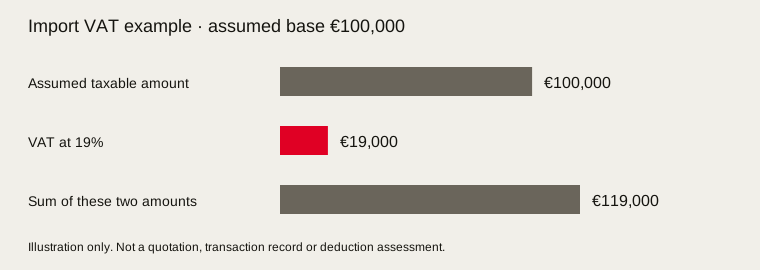
| Item | Calculation | Amount |
|---|---|---|
| Assumed import VAT taxable amount | Input assumption | €100,000 |
| Illustrative import VAT | €100,000 × 19% | €19,000 |
| Sum of these two amounts only | €100,000 + €19,000 | €119,000 |
Rate source: German VAT Act, section 12(1), checked 2026-10-23. Amounts are assumptions and arithmetic, not transaction data, a customs assessment or experimental results. This is not a total landed-cost quote and says nothing about deduction entitlement, payment timing or deferral.
In your own quote, keep the product price, transport and handling, duties, import VAT and service charges identifiable. Have the classification, origin and taxable value checked for the actual pump package. Do not use an assumed zero duty rate, or a hoped-for VAT recovery, to make the commercial margin work.
5. A delivered pump is not necessarily an installed pump
For a pump skid, the customer may expect unloading, positioning, pipework connections, electrical work, commissioning or an acceptance run. Ask it to mark which of these it expects from the seller. Delivery terms do not replace a separate agreement on those tasks. ICC’s DDP explanation also distinguishes delivery from unloading responsibilities. [1]
If your contract includes installation or site work, flag that before requesting a VAT conclusion. A supply-only review should not be carried over to a wider project without checking the changed scope. We do not promise pump installation, commissioning, customs representation or technical acceptance as part of a company or VAT engagement.
Bring us the order structure, not just a request for a VAT number
We provide German company formation and VAT registration and filing services. Send us the seller’s and buyer’s countries, the proposed contracting entities, the import route and destination, the delivery term, and whether the order includes site work. If you already have a draft quote, the relevant pages with sensitive commercial details removed are enough to start the discussion.
We will confirm the company and VAT work you need before engagement. Your customs provider should separately confirm the clearance arrangements, and your technical team should confirm the equipment and site responsibilities. Email contact@jwhelp-eu.com to discuss the transaction before you fix the DDP price.
Sources and checks
Sources checked: 2026-10-23
- ICC Academy: DDP and DAP responsibilities under Incoterms® 2020
- European Commission: purpose of an EORI number
- German VAT Act, section 3(8): place of supply on import
- German VAT Act, section 15(1)(2): import VAT deduction
- German VAT Act, section 12(1): standard 19% rate
Before we agree the scope: The seller and buyer entities, country of entry, customs representation, commodity classification, taxable value, VAT entitlement and any installation work must be reviewed for the actual order before a binding scope or quote.