Before selling a screw compressor to a German factory, split after-sales support into fault intake, technical assessment, parts, site work and cost approval. A manufacturer offering a free part has not necessarily arranged someone authorised to fit it. A German company is not proof of model-specific repair capability.
Your proposal should let the order run in practice. When a buyer sends an alarm message, someone must own the information request, technical escalation and approval for the next action. “European after-sales support” alone does not describe that chain.
Why buyers look beyond the equipment price
Natural Resources Canada’s compressed-air guide illustrates a typical air-cooled compressor over its first ten years with two-shift operation: electricity 76%, maintenance 12%, equipment and installation 12%. This is a reference illustration, not German market data or a forecast for your machine. [Original guide, Figure 2]
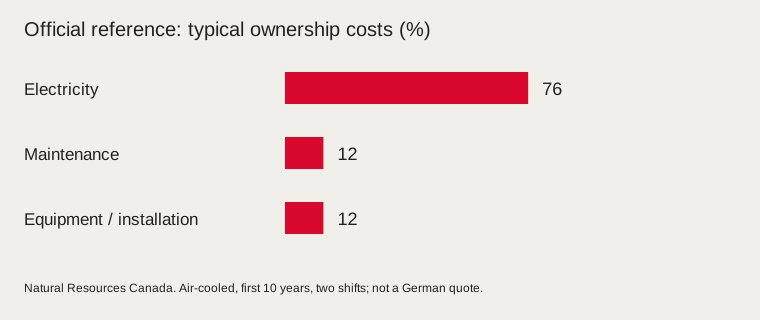
Natural Resources Canada: ten years, typical air-cooled compressor, two-shift operation. Electricity 76%, maintenance 12%, equipment/installation 12%. Historical reference assumptions, not a JWhelp test, German price or service promise. Checked 24 October 2026. Original guide
| Reference component | Illustrative share |
|---|---|
| Electricity | 76% |
| Maintenance | 12% |
| Equipment and installation | 12% |
You need not promise lifetime cover to answer a support question. Establish whether the buyer wants continuity, a predictable budget or a local contact to satisfy purchasing procedures. Each calls for a different arrangement.
Separate five support responsibilities
| Task | Who must confirm it | Useful record |
|---|---|---|
| Fault intake | Agreed manufacturer/customer contact | Serial number, alarm, operating context and contact |
| Technical assessment | Manufacturer or competent model-specific specialist | Assessment and required site conditions |
| Parts supply | Manufacturer confirms compatibility and terms | Part/revision, approval and cost allocation |
| Site work | Provider with confirmed capability and authority | Scope, personnel, timing and safety arrangements |
| Cost approval and closure | Contractual commercial owner | Payment basis, old-part destination and closure |
This is our suggested allocation, not a statement of statutory warranty duration. Different assemblies and consumables may have different agreed treatment. People handling reception or deliveries should not be expected to make technical operating decisions.
Work through a hypothetical fault budget
These are invented planning inputs, not a customer case or quotation. Suppose the manufacturer agrees to supply a part free of charge, but local inspection costs €180, site labour €320 and parts transport €60. Other conditions are excluded. The part being free does not allocate the additional €560.
| Hypothetical item | Amount | Agree in advance |
|---|---|---|
| Manufacturer part | Free in this example | Who approves compatibility and responsibility |
| Local inspection | €180 | Who funds assessment before responsibility is known |
| Site labour | €320 | Included tasks and approval for extra work |
| Parts transport | €60 | Recipient and any old-part return |
| Three cash items combined | €560 | Excludes other possible costs; not a price offer |
If the cause is later identified as site piping, operating conditions or use, who pays? If the customer disputes the assessment, what happens before further work? Resolve that process before dispatching personnel. Free parts alone do not imply reimbursement of energy costs, downtime or replacement equipment.
Prepare model-specific handover records
Arrange the model, serial number, controller version, operating and maintenance documents, manufacturer-approved parts identification and technical contact. Record the customer location, air requirements and handover condition. A general product brochure will not identify the configuration behind a later alarm.
- Define one intake route. Specify the basic information needed so the customer is not passed among several contacts.
- Define approval authority. Identify who can authorise parts, assessment, charges and replacement; commercial staff should not overrule technical assessment.
- Describe site scope precisely. Distinguish inspection, installation, commissioning and repair; confirm qualifications and equipment where needed.
- Close the record. Link the outcome, replacement and old-part treatment to the serial number.
These are business handover suggestions, not repair instructions. Competent personnel must handle isolation, work and return to service using the appropriate procedures.
Separate local business presence from technical work
A German company can hold an agreed contracting, invoicing or communication role. Actual repair capability depends on personnel, manufacturer involvement and site conditions. Confirm who is contractually responsible and who performs the work as separate questions.
We can help with German company formation, VAT and ongoing filings, together with agreed local commercial communication and equipment-introduction support. This is not a blanket offer to install or repair compressors or perform pressure-equipment work. Providers, authorisations and scope must be confirmed for the project.
Discuss the actual buyer requirements
Send the model, German location, proposed delivery route, manufacturer parts/technical support and buyer’s requested terms. We can discuss which local business and commercial support functions need to be arranged.
Still to confirm: provider capability and authority, site conditions, contractual responsibilities, labour/parts charges and availability. Send us the local-support requirements →
Sources and checks
Checked: 2026-10-24