Before placing MIG/MAG machines with a German dealer, distinguish the demonstration unit, the actual saleable configuration and the technical-support route. Product reception and sales representation do not establish repair capability. We can handle agreed local meetings, introductions, parts reception and commercial follow-up; welding trials, electrical work and fault decisions require appropriate technical personnel.
Dealer questions quickly become configuration questions: is the feeder included, which torch interface is supplied, who provides trial consumables, and which board revision fits the delivered unit? Answer these before the first customer order becomes an improvised bill of materials.
Define the dealer’s product range
List the power source, feeder, torch, leads, accessories and software revision separately. Borrowed demonstration components should not silently become part of a standard supply item. Have the manufacturer approve configurations instead of asking a local sales contact to invent compatibility.
For a welding trial, define the material, purpose, personnel and site conditions first. Our commercial reception is not a promise to perform welding tests or electrical repairs. The manufacturer and relevant economic operators must address model-specific compliance requirements; dealer authorisation is not product conformity evidence.
| Record | Minimum contents | Buyer question answered |
|---|---|---|
| Demonstration unit | Serial, configuration and demonstration scope | What can actually be shown? |
| Supply item | Fixed part/configuration, accessories and documentation | What does the offer contain? |
| Support resources | Contacts, information, parts and authority | Who handles the next problem? |
Separate active and idle energy questions
The Commission’s published2020 EU27 installed-equipment baseline uses440 active and1560 idle hours per year. It is a historical average model, not a German MIG/MAG demand estimate or a prediction of your buyer’s usage. It demonstrates why idle operation deserves a separate question in an operating-cost discussion.
Historical official active/idle operating-time model
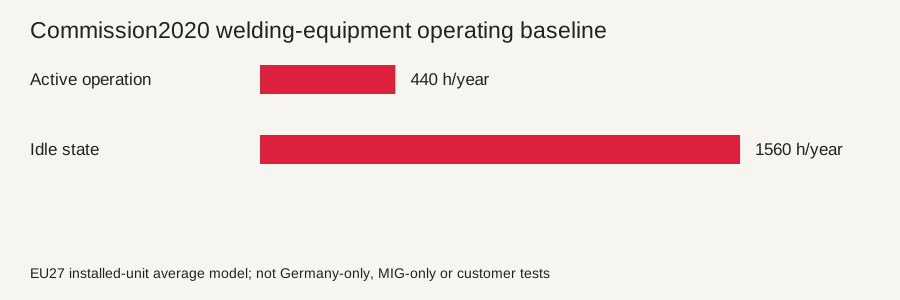
Ask what operating conditions support the manufacturer’s input-power figure and what its idle-state definition includes. Output, duty, accessories and the customer’s use pattern matter. Do not turn a single catalogue efficiency value into a yearly bill guarantee. Request the missing evidence when the supplied conditions do not answer the buyer’s question.
Work through a bounded cost example
These invented inputs are independent of the historical hours above. Assume 8kW active input for 300h/year,0.05kW idle input for 1200h/year and electricity at €0.25/kWh. Only those two states are included; this is neither our testing nor a manufacturer claim.
| Assumed item | Calculation | Result |
|---|---|---|
| Active energy | 8kW×300h | 2400kWh |
| Idle energy | 0.05kW×1200h | 60kWh |
| Two-state electricity cost | 2460kWh×€0.25 | €615/year |
| Excluded costs | Gas,wire,fixtures,labour,downtime | Assess separately |
A changed feeder, cooling arrangement or working pattern requires a fresh measurement boundary. Price trial gas, wire, consumables, transport and technical attendance separately and state customer-supplied items. Two trial offers with different inclusions are not directly comparable.
Give each support task a proper owner
Ask the manufacturer to distinguish consumables, replacement parts and components needing a technical decision. Torch-related part numbers, control-board revisions and software conditions need product-specific approval. A German delivery address is not proof of model-specific repair competence.
| Customer report | Agreed local coordination | Technical owner’s output |
|---|---|---|
| Delivery differs from order | Collect labels,order lines and configuration evidence | Configuration finding and remedy |
| Wire-feed or welding concern | Record reported behaviour,model,revision and existing evidence | Diagnostic information request and competent-person arrangement |
| Replacement requested | Coordinate parts receipt,dispatch and progress | Approved part,compatibility and work responsibility |
| Recurring issue | Consolidate tickets,dates and revisions | Manufacturer quality/technical review and action |
Commercial staff should not guess protective settings or provide hazardous operating instructions. Do not promise that a board replacement will resolve a fault without technical approval. Define evidence, authority, shipping and personnel costs for warranty, paid service and factory-return routes before a stoppage becomes a negotiation.
Write the trial-sale terms before dispatch
Specify territory, product line and channels, then separate sample ownership, stock risk, price authority, credit, contracting and payment. A local representative cannot enlarge exclusivity, discount or technical commitments by conversation.
Use a handover sheet naming the manufacturer’s technical owner, the dealer’s authorised commercial contact and the local support assignment. Give commercial changes, technical changes and service costs their own approval paths. Agreement to try one unit is not a purchase commitment or acceptance of the whole range.
Choose German commercial support
Send the model/configuration list, target dealer channel, present order stage, manufacturer support route and proposed local assignment. We can discuss German reception, showroom meetings, authorised introductions and follow-up. Confirm parts-handling conditions before shipping.
Company formation, VAT and local trading arrangements can be considered together. Scope, competence, authority, fees and confidentiality need agreement; we do not guarantee dealer sales or unverified repair capability. Discuss German MIG/MAG commercial support →
Sources and checks
Checked: 2026-10-28