If a German buyer asks for a local company, obtain the actual supplier-onboarding requirement before incorporating. The obstacle may be the contracting entity, VAT details, a local demonstration, after-sales contact or payment protection. These are separate needs. We can align formation and tax work with agreed German presentation and commercial support, so the entity addresses the purchase process rather than leaving technical qualification unresolved.
For a CNC lathe, machining centre or grinding machine, the route depends on the product, buyer and sales model. An end-user factory and a distributor may ask for different evidence. Start with the specific step that the proposed German company must perform.
Ask procurement four precise questions
Does the supplier system require a German-registered entity, or can it accept a foreign supplier with specified tax information? Must the seller, invoice issuer and receiving bank account be that same entity? Is German stockholding or a local service contact required? What workpiece, accuracy or acceptance evidence does the technical department still need?
Ask for a shareable onboarding checklist, contract clause or written clarification. A preference for local presence is different from a mandatory supplier-system rule. If an internal document cannot be shared, identify the rejected step and acceptable alternative evidence.
| Actual request | Evidence to obtain | What it does not establish |
|---|---|---|
| German contracting seller | Onboarding and contract-entity terms | An incorporated company wins the order |
| VAT/tax information | Identifier type, purpose and transaction | A VAT number is a German company |
| Viewing or machining trial | Machine, site, workpiece and acceptance criteria | A registered address can run trials |
| Local after-sales/parts | Scope, technical authority, parts and charges | A contact person is a qualified repair operation |
Separate entity, tax and execution capability
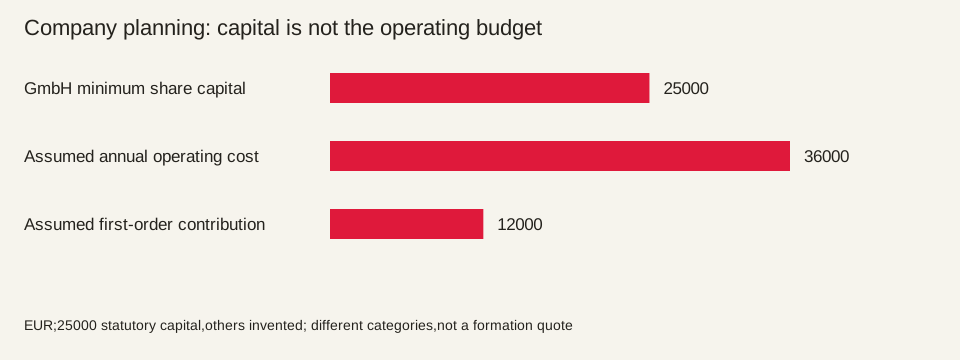
A German GmbH is one possible structure. GTAI states minimum share capital of EUR 25,000, with at least half of that minimum, EUR 12,500, paid for registration in the standard cash-contribution case. Have the notary confirm the applicable conditions. Share capital is neither our fee nor a complete start-up budget.
Bookkeeping, tax filings, accounts and the actual trading role still need implementation. A machine-tool supply involving installation or modification requires review of the contractual facts. Demonstrations, parts and technical service need their own operating arrangements; commercial registration does not create them.
Test the budget against order contribution
Keep share capital, one-off setup expense, annual fixed expenditure and order-specific costs separate. In an invented plan, assume annual local fixed expenditure of EUR 36,000 and EUR 12,000 contribution per machine after its goods, freight and attributable service costs. Three units would cover that fixed expenditure.
At EUR 8,000 contribution, the whole-unit requirement becomes five; at EUR 18,000, it is two. This is not a sales forecast. Income tax, finance, stock, bad debts and one-off investment are excluded, and share capital has not been charged as an expense. Replace the assumptions with documented numbers for your business.
Keep capital, fixed cost and order contribution separate
| Budget category | Your input | Use in the decision |
|---|---|---|
| Capital/contribution plan | Notary-confirmed amount and timing | Funding, not a service-price estimate |
| One-off expenditure | Actual formation, translation, notarial scope | First-year cash requirement |
| Fixed operations | Applicable accounting, address, staff, insurance | Order-coverage calculation |
| Order contribution | Revenue less real variable costs | Recurring economic basis |
| Working capital | Stock, payment terms, taxes, after-sales | Avoid reliance on accounting margin alone |
Run technical and commercial approval together
A machining-centre buyer may request a trial part. Agree material, blank, tooling, fixtures, program, measurement method and acceptance criteria with the manufacturer and buyer’s engineers. One accepted sample does not prove every application or the entire machine range.
Maintain a separate commercial issue list: currency, payment protection, delivery terms, confidentiality, software, warranty, site-service charges and dispute handling. We can coordinate agreed German reception, presentation and authorised follow-up; the manufacturer retains responsibility for technical statements. Both approval tracks must support a contract.
Assign the ongoing operating responsibilities
If customers genuinely require a German seller and you intend recurring local sales, assign the complete chain: purchase, import, stock, invoicing, payment and warranty. Specify the bookkeeping records and filing handovers rather than treating registration documents as the end of implementation.
If you are validating demand, first ask whether foreign contracting plus a limited viewing, trade-fair or representation assignment is acceptable. Any registration, tax or operating obligations still need a fact-specific check; limited activity is not an automatic exemption.
Bring the actual onboarding obstacle
Send the machine type, target market, shareable customer requirements, expected orders and existing entity. We can separate the entity, tax and local-execution decisions before discussing formation and ongoing support. If no buyer has imposed a requirement yet, begin with a specific order scenario and budget.
Sources and checks
Checked: 2026-10-30