If a German prospect wants to test a laser cutting machine with their own sheet metal, agree the trial brief before shipping a demonstration unit. Record the part, material, acceptance criteria, timing method and person authorised to approve the result. Establish process feasibility at the manufacturer’s facility first, then decide whether an on-site demonstration in Germany will move the purchasing decision forward.
Your customer needs evidence that the machine can fit their production, not just a convincing cutting video. Purchasing will question the scope and price, production will question cycle time, and quality will question the part. A useful demonstration gives all three teams a result they can review together.
- Freeze the representative part and its quality requirements before comparing power ratings or speeds.
- Keep a demonstration, process evaluation, factory acceptance and site acceptance distinct.
- Check the machine, premises, safety conditions and operator before committing to live cutting in Germany.
What published cutting trials can—and cannot—tell you
Mahrle and colleagues published tests on 10 mm AISI 304 stainless steel in 2021. Their static-beam study comprised 21 runs varying laser power, focus and cutting-gas parameters. Table 3 reports cutting-speed limits of 0.70 m/min minimum, 1.05 mean and 1.60 maximum. The system used a rated 4 kW source; that does not mean every run used a fixed 4 kW setting. [Original methods and Table 3]
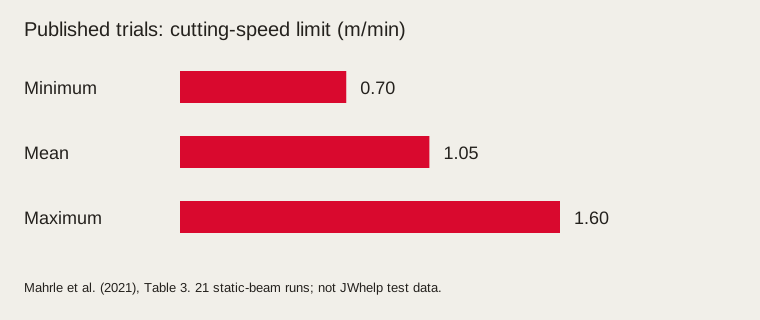
Original study: 2021. Checked: 2026-10-23. Replotted from Table 3 for the static-beam trials on 10 mm AISI 304. These are summary statistics, not three machines. The metric is the speed limit for a complete cut under the study conditions, not acceptable production output, a current machine specification or a JWhelp experiment. Original paper · Chart data
| Statistic | Cutting-speed limit (m/min) |
|---|---|
| Minimum | 0.70 |
| Mean | 1.05 |
| Maximum | 1.60 |
The historical experiment will not select a machine for your customer. It does show why a single maximum-speed claim is an incomplete purchasing comparison. A buyer asking for parts that go straight to welding or assembly needs more than evidence that the beam can cut through a sheet. Small features, surface condition and downstream work may change the decision.
1. Build a trial brief the buyer can approve
You do not need the customer’s entire confidential drawing library to begin. Ask for one representative drawing they are authorised to share, agree confidentiality and sample retention, and identify the revision. Link the material batch, sample numbers and test records from the start.
| Agree before the trial | Record together | Why it matters |
|---|---|---|
| Workpiece | Material grade, thickness and condition; drawing revision, outline and critical features | A supplier’s preferred stock may not represent the customer’s material |
| Acceptance | Dimensions, tolerances, edge and burr requirements, permitted secondary operations and agreed measurement method | A complete cut is not necessarily an assembly-ready part |
| Process settings | Actual power, gas and consumption measurement, focus, nozzle and program version | A repeat test needs a traceable setup |
| Timing | Loading, positioning, piercing, cutting, unloading and sorting; interruptions and failures | Beam-on time is not whole-batch lead time |
| Evidence and sign-off | Numbered samples, measurement locations, raw readings, video, operator and decision owner | An unlabelled photograph cannot resolve a later disagreement |
This is our suggested planning checklist, not a universal acceptance standard. Your technical team and the buyer should agree repetitions, sample quantity, instruments and witnessing according to the application. Qualified specialists remain responsible for the measurements, technical decisions and equipment safety assessment.
2. Compare machines on the same basis
If the buyer is evaluating two suppliers, retain one genuinely comparable task: the same drawing revision, material requirements, acceptance criteria and start/stop points. Suppliers can optimise settings, but should record the final program and setup. Do not compare one supplier’s deburred component with another supplier’s as-cut sample without making that difference visible.
Check what the trial actually delivered before comparing the stopwatch results. Do holes fit the intended assembly? Can the edge proceed to the next operation? Are rejected pieces included in the record? If a run stopped because of material condition, list the cause rather than removing the run. The customer needs a defensible choice, not a table containing only each supplier’s best attempt.
3. Calculate cost per acceptable part
The following inputs are hypothetical, not test results, quotations or a customer case. Assume each option processes 100 blanks and the same illustrative machine-occupancy rate of €60/hour. Include gas, consumables and secondary work in the comparison.
| Hypothetical input | Option A | Option B |
|---|---|---|
| Whole-batch machine time | 2.0 hours | 1.5 hours |
| Acceptable pieces | 95 | 90 |
| Occupancy cost (hours × €60) | €120 | €90 |
| Gas, consumables and secondary work combined | €30 | €75 |
| Total ÷ acceptable pieces | €150 ÷ 95 = €1.58/part | €165 ÷ 90 = €1.83/part |
The calculation does not establish that a slower machine is cheaper. Replace every input with the buyer’s actual task data and agreed cost assumptions. Decide consistently whether material losses, labour, depreciation, downtime and rework belong in the comparison. A short sample run is not proof of a long-term yield rate or annual savings.
4. Decide whether a German demonstration unit is justified
A local demonstration becomes easier to justify once the customer has supplied a meaningful part, the initial trial has a usable record and the customer has identified what an in-person visit must resolve. Shipping a costly machine before the application and decision owner are known leaves the local team trying to reconstruct the brief.
Before arranging live cutting, check power, dimensions and handling, extraction, gas, laser protection and operator requirements. Available warehouse space is not evidence that live cutting is suitable there. The exact machine, permitted demonstration activities and operating responsibilities need to be confirmed against the site.
We have a self-operated warehouse, showroom and mechanical-equipment engineers in Germany. We can discuss customer visits, equipment introductions and agreed demonstration support with you. The manufacturer must provide accurate technical information, operating requirements and the necessary technical involvement. Our local support does not replace process testing or technical acceptance; live cutting is subject to the equipment and site checks.
Turn the demonstration into an agreed next step
Close the visit with three lists: confirmed, still to verify, and outside this session. Identify the drawing, material and result that were confirmed. Assign an owner and deliverable for each open point. If extended operation, automated integration or the customer’s installation conditions were not assessed, keep them outside the demonstration conclusion.
Then specify demonstration scope, factory acceptance testing (FAT) and site acceptance testing (SAT) separately in the commercial documents. Agree witnessing, sample-material costs, rework responsibility, handover, sign-off and payment triggers. A successful visit supports the purchasing process; it should not silently become full machine acceptance.
What to send us to discuss local support
Send the machine model, a drawing you may share, material and thickness, the customer’s German location and the decision they want the visit to support. Include any initial cutting records. We can check whether local presentation, reception and engineering support fit the plan before agreeing equipment and premises arrangements.
To confirm for your project: site and operating suitability, safety requirements, manufacturer support, test and acceptance methods, scope, fees and availability. Discuss your German demonstration plan →
Sources and verification
Sources checked: 2026-10-23