When sending IO-Link industrial sensors to a European buyer, do not confuse sample delivery with an active evaluation. Link the exact part, IODD, master, control system, settings and acceptance objective before arranging local introductions and sales follow-up. We can receive samples and coordinate agreed communication; selection, programming and electrical commissioning remain with the manufacturer and buyer’s technical personnel.
“Will it work with our system?” can be a mechanical, communication, data-interpretation or application question. A protocol name does not answer all of them. A powered sample also does not establish that the production supply revision has passed the buyer’s evaluation.
Protocol support is not complete interchangeability
The IO-Link Community describes point-to-point communication, distinguishes it from a fieldbus and explains the role of the IODD device description. Its technology page also notes that sensor process data, parameters and functions are not all standardised. Matching connectors and protocol labels therefore do not establish application equivalence.
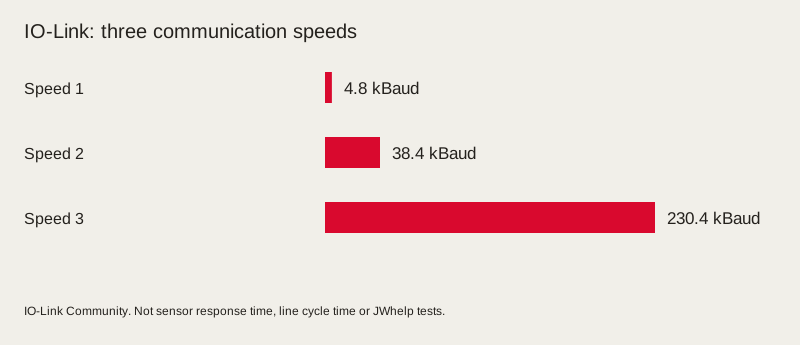
The official communication speeds below can help identify documentation requirements. They are not sensor response times, measured production performance or a promise about a line cycle. Check what the specific device supports.
Three communication speeds listed by IO-Link
Match the sample and customer system
Replace “send some sensors” with a traceable package: full part suffix, hardware and firmware revision, sample identification, buyer’s technical contact, master model, intended control system, connection and power requirements, and the manufacturer’s matching IODD. If only the application is known, have the technical team select candidate products before shipping.
| Item | Input needed | Who resolves it |
|---|---|---|
| Purchasing part | Suffix, connection, range and revision | Manufacturer and buyer |
| Device description | Matching IODD and instructions | Manufacturer technical team |
| System environment | Master, controller and configuration revisions | Buyer technical team |
| Evaluation objective | Agreed performance criteria and test conditions | Buyer and manufacturer |
| Commercial next step | Quantity, destination, timing and quotation scope | Authorised commercial contacts |
Receiving a parcel, welcoming a visitor and commissioning a device are separate responsibilities. State who does each before dispatch. Do not label a commercial contact as the technical operator. If the revision changes, establish whether the former IODD and evaluation remain applicable.
Compare evaluation records properly
Consider a hypothetical buyer A using one master and buyer B using another system. Both reports say “communication works”. That alone does not show that the same functions were evaluated. The following is a proposed comparison record, not experimental data.
| Question | What “works” leaves unresolved | Next action |
|---|---|---|
| Same device revision? | Part, firmware, IODD and configuration | Align revisions before interpreting differences |
| Same function? | Process value, diagnostics, parameter access or restoration | List results against the buyer objective |
| Comparable conditions? | Installation, target/media, environment and method | Identify differences explicitly |
| Ready to buy? | Supply revision, support, destination and quote | Separate technical findings from commercial approval |
If details are missing, ask which evaluation item is blocked, which document the manufacturer needs to provide and who should join the next discussion. Repeatedly asking whether testing is finished adds little. Route operating changes through the appropriate technical people rather than guessing settings from a sales conversation.
Define local sales authority
A local representation assignment can start with a product family, a set of samples and defined follow-up work. We can introduce agreed products, collect requirements, transmit quotations and coordinate order questions. Pricing, credit, exclusivity, quality commitments and the contracting party require explicit written authority; a European presence does not confer unrestricted agency.
For an explicitly hypothetical change request, suppose a buyer wants new firmware at the old price. The technical team first addresses the effect on function and records. The commercial owner then decides price and supply terms. Local coordination brings those answers back to the same buyer task without making either decision on their behalf.
Give each evaluation a next action
| State | Record | Action |
|---|---|---|
| Incomplete information | Missing item, owner and expected response | Obtain the information; do not infer lack of interest |
| Technical issue | Observed behaviour, revisions and permitted evidence | Escalate for technical assessment |
| Evaluation can progress | Tested and untested scope and conditions | Agree further verification or a meeting |
| Procurement discussion | Configuration, quantity, destination and authority | Written quotation and contract review |
Our self-operated German warehouse and showroom can be an agreed sample-reception or meeting point. They are not a claimed certified sensor laboratory. Confirm facilities and personnel before booking. We can also discuss company formation, VAT and local commercial support where the trading arrangement calls for them; technical and purchasing decisions retain their proper owners.
Choose the local work you need
Send the part and revision, target country, customer system, current obstacle and proposed reception, introduction or follow-up task. Distinguish a parcel handover from a formal technical evaluation with specialist personnel.
To confirm: product/IODD match, site capability, commercial authority, fees, delivery terms and confidentiality. Discuss European sensor sales support →
Sources and checks
Checked: 2026-10-26