Before inviting a buyer to see an injection moulding machine in Germany, distinguish a product visit from a trial using the buyer’s mould and material. A machine on display does not by itself provide a production-ready trial facility. We can arrange agreed local reception and product introductions; process development, operation and acceptance require the right technical people and site conditions.
Ask what decision the visit must support. A buyer checking the machine layout needs a different session from a buyer comparing the cost of moulding a particular component. Agree that decision before booking travel or promising trial results.
Define the buyer decision
For supplier screening, a configured-machine presentation may be enough. For a technical shortlist, identify the actual component, material and mould. For a purchasing decision, agree which results will inform the quotation and which will require a later acceptance test. Do not describe all three as “a quick demo”.
| Decision | Inputs | Useful output |
|---|---|---|
| Screen a model | Configuration, dimensions and interface documents | Whether to continue technical discussions |
| Assess a component | Authorised drawings, mould and material information | Trial plan and unresolved conditions |
| Compare production performance | Same product and agreed measurement boundaries | Conditional cycle, quality and energy record |
| Prepare purchase | Defined scope and acceptance arrangements | Quotation scope, responsibilities and next actions |
Machine ratings versus product trials
EUROMAP 60.1, version 3.0 of January 2013, concerns machine-related efficiency classification. EUROMAP 60.2 addresses a specified machine producing a specified product through a specified process. These are technical recommendations; a machine classification is not a promise about every customer mould.
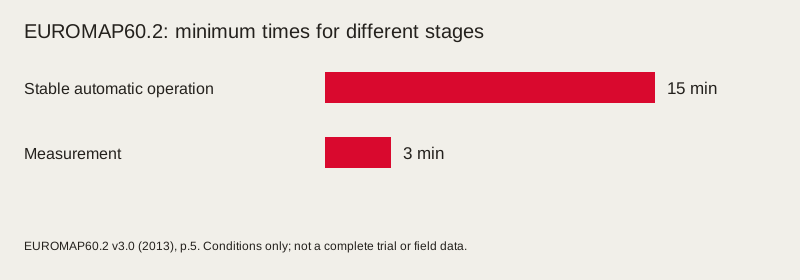
The two time conditions below come from printed page 5 of 60.2. They illustrate why seeing movement is different from collecting comparable evidence. They are not the total duration of a trial or measurements made by JWhelp.
Two timing conditions in the original recommendation
Prepare the mould, material and site
Have the manufacturer and mould provider check the mounting arrangement, dimensions, weight and required opening stroke against the actual demonstration machine. State the exact resin grade and agreed preparation, rather than treating a generic material name as a process specification. Agree who may receive confidential component and mould files.
| Item | Responsible party | If unresolved |
|---|---|---|
| Machine/mould fit | Manufacturer and mould provider | Review documents before promising a mounted trial |
| Material and quality criteria | Buyer and manufacturer process team | Define the grade and rejection criteria |
| Power, fluids, cooling and handling | Technical team and site provider | Check individually; a showroom is not automatically a production facility |
| Operation and protective measures | Competent technical personnel | Do not run a loaded trial without confirmed arrangements |
| Samples and data | Buyer and manufacturer | Agree identification, ownership, recording and removal |
Read an explicitly hypothetical calculation
The following inputs are invented for calculation practice. They are not measured results, customer experience or a quotation. Suppose an agreed measurement boundary records 24kWh while producing 60kg of output. The ratio is 0.40kWh/kg. If only 48kg meets the assumed quality criteria, energy per kilogram of accepted output is 0.50kWh/kg. The denominators answer different questions.
| Assumed calculation | Result | Keep with the figure |
|---|---|---|
| 24kWh / 60kg total output | 0.40kWh/kg | Boundary, period and total-output definition |
| 24kWh / 48kg accepted output | 0.50kWh/kg accepted output | Assumed quality and rejection basis |
| Apply either figure to another mould | Not established | Reconfirm product, material and operating conditions |
This is an arithmetic comparison of management measures, not a claim that the accepted-output calculation is the EUROMAP method. A comparison under 60.2 requires its agreed documentation and measurement arrangements. State whether auxiliary equipment is included before comparing figures.
Record a defensible handover
Before the appointment, circulate the objective, configuration, available facilities and exclusions. The technical owner decides readiness to operate; reception staff do not authorise a trial. Identify the machine, mould, resin, parameter revision and samples in the record. Separate observations from unresolved manufacturer questions and items needing another run.
If the material, mould or program changes during the visit, record when and why. Decide which measurements no longer describe the new setup. Give the commercial follow-up team the conditional conclusions, rather than an unlabelled video that can be mistaken for a performance commitment.
Arrange local support without confusing roles
Our self-operated German warehouse and showroom can support agreed machine storage, scheduled visits, introductions and buyer communication. Machinery-engineer involvement is scoped for the project. It does not establish injection-moulding process-development, trial or independent acceptance capability. Confirm the technical provider and facilities before promising an operating session.
Where ongoing display or sales require a local business structure, we can also discuss company formation, VAT and commercial support. Keep the storage agreement, demonstration responsibilities and sales contract distinct. A person receiving a visitor does not automatically warrant machine performance.
Send us the visit requirements
Send the machine configuration, dimensions and weight, buyer’s decision, proposed mould and material, German location and timing. Tell us what is still missing. We can then confirm the local work we can undertake and which technical arrangements remain necessary.
To confirm: technical provider, machine/mould suitability, utilities, safety, fees and sample/data handling. Discuss your German machine visit →
Sources and checks
Checked: 2026-10-26