For an industrial vacuum-pump order in Germany, a request for 100m³/h and a minimum pressure is not a complete selection basis. Identify the operating pressure, gas throughput, piping and contamination conditions before agreeing a trial. We can coordinate agreed German sample receipt, documents and authorised commercial follow-up. Hazardous-media assessment, system design and technical acceptance remain with the appointed competent parties.
A packaging-machine builder, a workholding application and a drying system may all request a vacuum pump while needing different cycles, media and pressures. Establish whether the buyer wants an unchanged replacement, faster evacuation or a different process before selecting a larger nominal size.
Specify the pressure basis
Request absolute or gauge pressure, units, measurement location and operating conditions. A message saying minus 0.9bar is not a complete requirement. Separate the lowest attainable pressure from the pressure that must be maintained in production.
Pfeiffer distinguishes pumping speed, throughput and ultimate pressure and describes speed against inlet pressure. Obtain the relevant gas/configuration curve or a written manufacturer response. A minimum-pressure value alone cannot establish process capacity.
Relate pumping speed to process demand
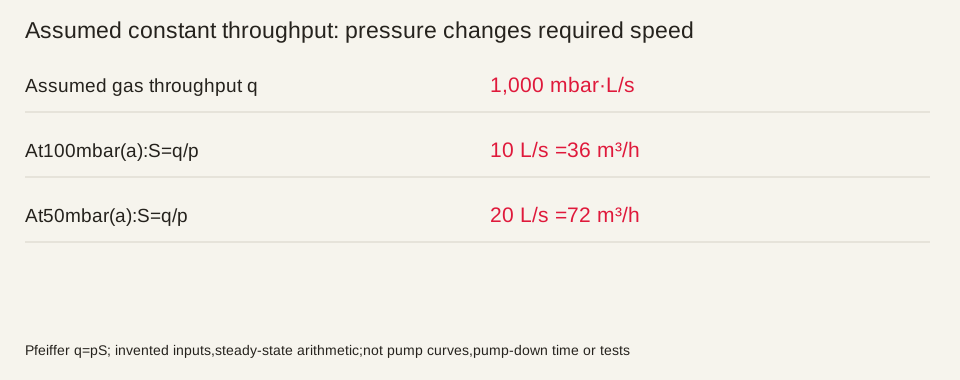
Use Pfeiffer’s q=pS relationship for an invented example. At an assumed gas throughput of 1,000mbar·L/s,100mbar absolute requires 10L/s or 36m³/h;50mbar absolute requires 20L/s or 72m³/h. The unit conversion is 1L/s=3.6m³/h.
These are invented operating inputs and a steady-state arithmetic check on the same boundary. They are not pump-down times and omit pipework, leaks, outgassing and temperature effects. They do not establish that a pump nominally rated 72m³/h is suitable:the manufacturer must check performance at the actual working pressure and conditions.
Keep pressure, speed and throughput on the same stated basis
| Requested figure | Question still open | Manufacturer confirmation |
|---|---|---|
| Nominal 100m³/h | Required pressure, frequency and gas | Applicable curve and working point |
| Minimum pressure | No-load minimum or sustained process need | Definition, method and configuration |
| Faster evacuation | Volume, start/end pressures, cycle and gas | Pump-down method and configuration |
| Maintain vacuum | Continuous gas load, leaks, piping | Chamber-side capability and boundary |
Distinguish pump-port data from system performance
Request connections, pipe dimensions and length, valves, filters, volume, temperature and process media. Pump-port speed is not automatically effective speed at the workpiece or chamber. Workholding, packaging and drying also require different acceptance criteria.
Vapour, dust, corrosive, flammable or other hazardous media need manufacturer and competent specialist review. Specify acceptable gases, treatment requirements and responsibility. Ordinary storage or showroom reception does not establish permission to receive contaminated pumps or operate an unknown process. Pause affected site work until those conditions are clear.
Keep the trial boundary comparable
Before dispatch, agree the process gas, measurement points, instruments, starting state, valve positions and operating mode. For comparison with the old pump, record the same system and conditions;do not attribute a changed gas path entirely to the pump. Preserve raw records and differences from production.
Competent authorised parties perform installation and tests. We can coordinate the agreed reception, documents and commercial issues, not sign vacuum-performance or safety acceptance. External trials need an appointed party, fees, sample disposition and data-use authority.
| Stage | Record | Decision owner |
|---|---|---|
| Before shipment | Configuration, process, method, acceptance conditions | Customer/manufacturer technical owners |
| German receipt | Packaging, quantity, IDs, visible damage | Agreed recipient, not performance approval |
| Running trial | Pressure/time, conditions, alarms and differences | Authorised test party and customer |
| Supply approval | Version, limitations, open items, change procedure | Technical and procurement signatories |
Define delivery and support responsibilities
Specify accessories, filtration/exhaust treatment, media, consumables, instructions and technical support. Align stock, import, seller and invoicing with the actual transaction. Local installation or process adjustment is a separate assignment;shipping the pump to Germany does not include it.
A returned or trial pump may contain process residues. Have the responsible parties confirm cleaning, declarations, packaging and acceptance before return transport. Do not book ordinary warehouse receipt first and ask about past media later. Start faults with manufacturer decisions and records;parts, professional site work and charges follow the agreement.
Prepare the German assignment brief
Send the model, application, pressure basis, authorised process information and trial/order stage. Identify sample receipt, buyer communication, presentation or authorised quotation follow-up. We check the conditions and local assignment before confirming execution and entity/tax support.
Sources and checks
Checked: 2026-10-31