When selling industrial chillers to a German laser-machine builder or factory, put the quotation on a shared operating basis before answering whether 5kW is sufficient. Cooling capacity, electrical input, temperature stability and the setpoint range are different fields. We can coordinate agreed German presentation, document transfer and authorised commercial follow-up. The manufacturer and customer engineers retain selection and technical acceptance responsibility.
A buyer may send a machine nameplate, target water temperature and a request for a matching chiller. Establish whether you are quoting a defined unit or taking responsibility for the production system’s heat removal. A unit quotation should not silently become an all-year production-line temperature guarantee.
Separate capacity, power and stability
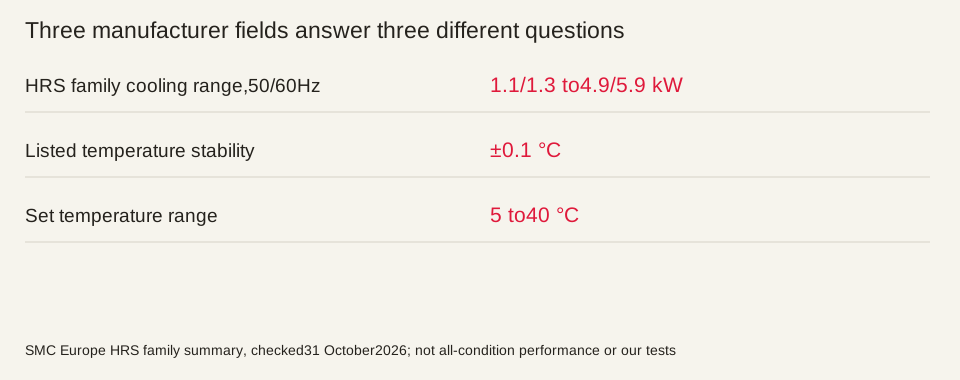
SMC Europe’s HRS family summary separately lists a 50/60Hz cooling-capacity range of 1.1/1.3 to 4.9/5.9kW, temperature stability of±0.1°C and a 5–40°C set range. These are fields from a particular manufacturer’s family, not our product specifications or a promise that one unit achieves every value under every condition.
Cooling capacity concerns heat removal, electrical input concerns supply and consumption, stability describes control behaviour under relevant conditions, and the set range identifies selectable temperatures. Keep them separate in the enquiry. An available setpoint does not prove full-load performance at the buyer’s site.
Compare the same fields on the same operating basis
Collect the quotation conditions
Obtain the equipment heat-load basis, duty cycle, continuous/intermittent operation, fluid and concentration, supply temperature, flow and pressure drop, ambient conditions and heat rejection. For a water-cooled unit, check facility water. Match the electrical supply and product version to the actual site.
If heat load is unknown, ask the equipment manufacturer for an appropriate design basis or have the responsible technical party define measurement. Do not equate a drive’s rated electrical input with the cooling load or guarantee results without fluid/flow/temperature evidence. We can progress the information handover, not sign the engineering selection.
| Input | Owner | Quotation effect |
|---|---|---|
| Heat load and operating cycle | Equipment manufacturer/customer engineers | Capacity and duty basis |
| Fluid, concentration, temperature, flow, pressure drop | Customer and chiller technical team | Materials, pump and pipework scope |
| Ambient, airflow/facility water | Site and appointed technical party | Heat rejection and extra work |
| Supply, connections, communications | Site owner and manufacturers | Version, interfaces and commissioning scope |
Write an executable acceptance record
Agree unit identification, measurement locations, instruments, logging interval, stabilisation basis and duration. For a comparison, keep fluid, load, ambient and measurement locations comparable. A temperature screenshot without operating conditions rarely establishes contractual performance.
An illustrative acceptance assignment would log supply/return temperatures, flow, ambient, alarms and power under the agreed conditions, then compare the record with the contract. This is a proposed workflow, not a measured trial. Limits, duration and tolerances must be set by the project’s responsible designers and acceptance parties.
| Acceptance item | Record | If unresolved |
|---|---|---|
| Identity/configuration | Version, fluid, settings | Check whether the test object matches |
| Conditions | Load, ambient, flow, measurement locations | Re-establish a comparable test |
| Results | Raw temperature/flow/power and alarms | Technical analysis, not a photograph-only verdict |
| Decision | Contract criteria, open issues, signatories | Assign correction, retest or conditional acceptance |
Allocate additional site work
Separate supply from unloading, positioning, pipes, fluid, facility water, electrical connection and control integration. Receipt or energisation at a German warehouse/showroom needs a specific feasibility check. A viewing assignment does not include installation into a production line.
Distinguish transport damage, missing documents, changed site conditions and performance disputes. Set notice, evidence and response responsibilities. A late request for more pipework or a new location needs an agreed scope and cost rather than an undefined delivery-inclusive promise.
Start support with usable records
Record the model, serial, alarms and any changes in fluid, load or ambient. The manufacturer directs diagnosis and parts decisions;competent authorised parties perform site work. Do not ask the customer to dismantle refrigeration/electrical equipment or assume we hold unconfirmed repair qualifications.
Identify the service contact, manufacturer support, parts supply, local assignment and labour/delivery charges. We can coordinate commercial communication and records;technical intervention is confirmed separately against actual capability and authority.
Define the German commercial assignment
Send the chiller model, production equipment, quotation/trial stage, buyer’s operating-condition sheet and the viewing, document-transfer or follow-up work you need in Germany. We confirm local commercial and entity/tax scope before discussing timing and fees.
Sources and checks
Checked: 2026-10-31