Do not qualify a gearmotor for a German conveyor merely because the power rating matches. Agree output speed, torque, load variation, mounting and shaft loads before offering a replacement. We can coordinate agreed German meetings, sample handling and commercial follow-up; the manufacturer and customer retain selection and engineering approval.
A nameplate enquiry can conceal a loaded start, frequent stopping, a changed connection or a previous failure. A cheaper nominal match does not settle those questions. Define what the customer needs to preserve before selecting a supply item.
Build the conveyor input record
Ask whether the target is belt speed, cycle time or output torque. The customer’s technical owner and drive supplier should agree the calculation boundary. Use the nameplate together with the connection and application record. A request for an equivalent is not a complete specification.
Distinguish a reducer-only offer from a complete gearmotor. If the customer retains a motor or inverter, identify that explicitly. Mark the motor, reducer, brake, inverter and coupling as included, customer-supplied or unresolved.
| Input | Decision | Owner |
|---|---|---|
| Load, speed, drum/sprocket and starting condition | Required output duty | Customer machine team |
| Run time, starts, shock and environment | Supplier application limits | Drive manufacturer |
| Orientation, shaft, key and support | Interfaces and shaft loads | Engineering contacts |
| Supply, controls, brake and inverter | Electrical boundary and compatibility | Electrical owner |
Separate power from output torque
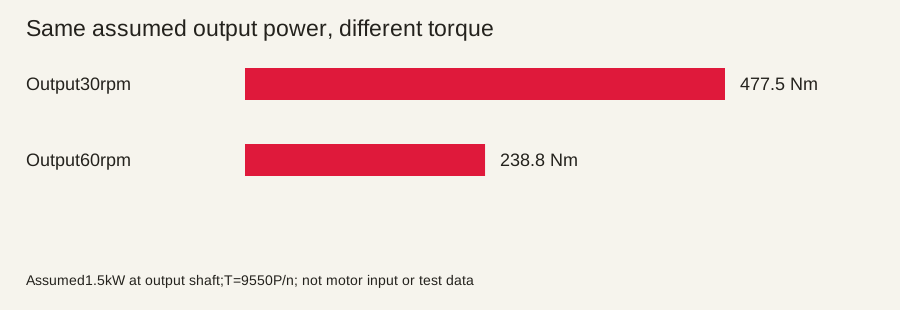
An invented example assumes 1.5kW of mechanical power available at the output shaft. The rotational-power relationship T=9550P/n gives approximately 477.5Nm at 30rpm or 238.8Nm at 60rpm. These are arithmetic points, not measured products.
Output-shaft power is not a motor nameplate input. This example excludes efficiency, thermal limits, starting peaks and permitted shaft loads. A higher calculated torque does not prove that a proposed housing, gear set or shaft can carry it.
Two calculated output points, not two product ratings
Compare service-factor definitions
SEW’s public selection guidance explains that catalogue service factors have manufacturer-specific definitions and cannot be compared directly between manufacturers. Its example divides 300Nm by 225Nm to obtain about 1.33. This is that supplier’s illustration, not a universal recommendation to specify 1.3.
Before comparing two offers, obtain the definitions, rating conditions and application assessment. A coefficient is not a product-quality score and does not by itself approve jammed operation, shock loading or frequent starts. Ask the supplier to state the basis and exceptions in writing.
| Observation | Unsupported conclusion | Needed evidence |
|---|---|---|
| Same nominal motor power | Same output speed and duty | Matched output requirements |
| Higher service factor | Better across brands | Definitions and comparable conditions |
| Mounting holes fit | All mechanical/thermal conditions fit | Full interface and mounting review |
| No-load rotation succeeds | Loaded continuous operation approved | Agreed application evaluation |
Approve mechanical and electrical interfaces
Obtain revision-controlled drawings, shaft extension, key, mounting dimensions and orientation-dependent lubrication/venting instructions. Identify the actual motor and accessories. A brake or retained inverter needs its own compatibility review; sales language such as European standard is not a substitute for documents.
Local meetings can support physical viewing and document review. A running demonstration needs a separate agreement on the site, competent people, insurance and safe arrangements. Our showroom is not offered as a load-test laboratory, and local attendance does not imply customer engineering approval.
Convert trial approval into supply
Name the sample, machine position, conditions, records and approval owner in a trial sheet. Separate sample price, freight, technical attendance and return costs. Agree ownership and damage handling before shipment.
Link the approved configuration and drawing to the production order. Set rules for changes, replacement revisions, warranty and site costs. Do not build local stock solely because a sample is in Germany. Distribution also needs territory, authority, pricing and credit responsibility agreed in writing.
Arrange local commercial support
Send the proposed model, output requirements, interface drawing, customer stage and German assignment. We can discuss agreed reception, storage, meetings, document handover and authorised follow-up.
Consider seller identity, company formation and VAT against the actual transaction. Selection, testing and repair require appropriately competent and authorised parties. Discuss German gearmotor commercial support →
Sources and checks
Checked: 2026-10-29